
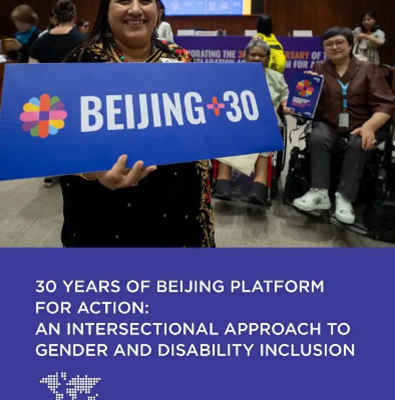
International Day of Persons with Disabilities
Every year, on the 3rd of December, the world marks the UN International Day of Persons with Disabilities. In 2025 the World Health Organisation (WHO) focuses on how inclusive financing can make a real difference to the lives, health and well-being of persons with disabilities, their families and society at large.
WHO reminds us that there are 1.3 billion persons with disabilities in world with about 4 in 5 persons with disabilities living in developing countries, and more than 80 per cent of them living in extreme poverty. These facts mean that achieving health for all must fundamentally address the needs of persons with disabilities. Yet, health care remains out of reach when health financing systems fail to consider and include people’s needs. From catastrophic out-of-pocket costs for essential services to the lack of coverage for treatments or medical devices, these gaps can push families into poverty and exclusion.
Inclusive health financing is an essential part of building sustainable health systems that cater to the needs of populations. When countries design financing systems that consider accessibility, affordability, and equity, they strengthen health systems for everyone.
Gender based violence (GBV) among Persons with Disabilities
Article 6 of the Convention on the Rights of Persons with Disabilities recognizes that women
and girls with disabilities are subject to multiple and intersecting forms of discrimination. Far too often, they experience discrimination, exclusion, isolation and denial of their dignity and autonomy, both in public and within their own families.
Article 16 of the Convention calls upon all stakeholders to implement measures to protect
persons with disabilities, both at home and in public, from all forms of exploitation, violence and abuse, including GBV.
- Women and girls with disabilities face barriers in most areas of life, particularly when it comes to equal access to education, economic opportunities, social interaction and justice; equal recognition before the law; and the ability to participate in politics and to exercise control over their own lives, for example on health care, including sexual and reproductive health services, and on where, and with whom, they wish to live.
- Women and girls with disabilities, and particularly those with psychosocial, hearing and intellectual disabilities, are more at risk of sexual violence and other forms of GBV due to negative attitudes by individuals and societies. Perpetrators may view them as ‘easy’ victims, exacerbating their vulnerability.
- Women and girls with disabilities frequently experience sexual exploitation due to extreme poverty and unmet needs for assistance.
- Girls with disabilities are particularly vulnerable to child marriage, especially when their families face economic hardship or social pressure and also if they are in camps for refugees and internally displaced persons. This is due to various factors, including socioeconomic stress, gender inequality, age and disability
- Sexual violence against men and boys with intellectual and physical disabilities has also been reported in several contexts. This underlines the intersection of disability with other dimensions of identity such as race, ethnicity and gender.
- GBV against persons with disabilities can sometimes take specific forms, such as abuse by the caregiver, by withholding medication or an assistive device and denial of necessities like food, money and toileting support.
- In emergency situations, the risks of GBV escalate, including against persons with
disabilities, as the structures and systems to protect women and girls are destroyed
The convention on the rights of persons with disabilities was agreed by the General Assembly of the UN in 2006 and came into force in May 2008 Read it here: https://www.ohchr.org/en/instruments-mechanisms/instruments/convention-rights-persons-disabilities

A Prayer for Justice, Inclusion, and Action
Let us pray
O God of compassion and justice, We lift up before You the 1.3 billion persons with disabilities across the world, especially those living in poverty and exclusion. We remember the women and girls who face multiple and intersecting forms of discrimination, isolation, and denial of dignity. We grieve for all who suffer violence, exploitation, and abuse, and for those whose voices are silenced by systems that fail to protect and include them. Grant us courage to act. Move our hearts and hands to build inclusive health systems, to design financing that is accessible, affordable, and equitable for all. Help us to challenge attitudes and structures that perpetuate gender-based violence, especially against those most vulnerable—women, girls, men, and boys with disabilities.
Inspire leaders, communities, and families to uphold the dignity and autonomy of every person.
Let us not turn away from the needs for education, justice, social interaction, and the right to participate fully in society. May we protect those at risk, especially in times of emergency, and ensure that no one is left behind.
Guide us to take real steps—
To advocate for policies that honour the Convention on the Rights of Persons with Disabilities,
To support survivors of violence and exploitation,
To create safe spaces and opportunities for all to thrive.Let our prayers become action,
Our compassion become justice,
And our communities become places of true inclusion. May it be so AMEN.
Images from UNWOMEN website